
Is Almond Milk Safe for PKD? A Renal Dietitian’s Guide
Jan 14, 2026Over the past several years, almond milk consumption has increased dramatically — with sales up more than 17% in the last five years. Almond milk is definitely having a moment.
But if you have polycystic kidney disease (PKD), the real question isn’t whether almond milk is popular — it’s whether it’s actually safe for your kidneys.
In this article, I'm going to break down the nutrition profile of almond milk, clarify what you need to know about oxalates, and let you know what I think as a registered dietitian who specializes in PKD nutrition— so you can decide whether almond milk belongs in your PKD diet.
Quick Answer: Is Almond Milk a Good Choice for PKD?
In general, when working with clients who have ADPKD, I recommend avoiding almond milk as a go-to milk choice. Instead, we look for a different milk, or milk alternative, that they like and one that meets their nutritional goals.
Keep reading to understand why almond milk may not be the best option if you have polycystic kidney disease.
How Almond Milk Is Made

The process for making commercially available almond milk is pretty straightforward. First, raw almonds are soaked for up to 20 hours, and then blanched. The blanching helps loosen the skin, which is then removed.
Next, the soaked and blanched almonds are finely ground and spun at a high speed. This separates the nut pulp from the liquid— the liquid is what we have come to know as almond “milk”. More often than not, almond milk is fortified with vitamins and minerals to make it more comparable to cow’s milk. More on this in a minute!
Stabilizers are also frequently added, and the liquid is homogenized so that the almond milk stays creamy and doesn’t separate. Before reaching grocery shelves, almond milk is heated to kill bacteria, rapidly cooled, and then packaged for sale.
Almond Milk Nutritional Facts
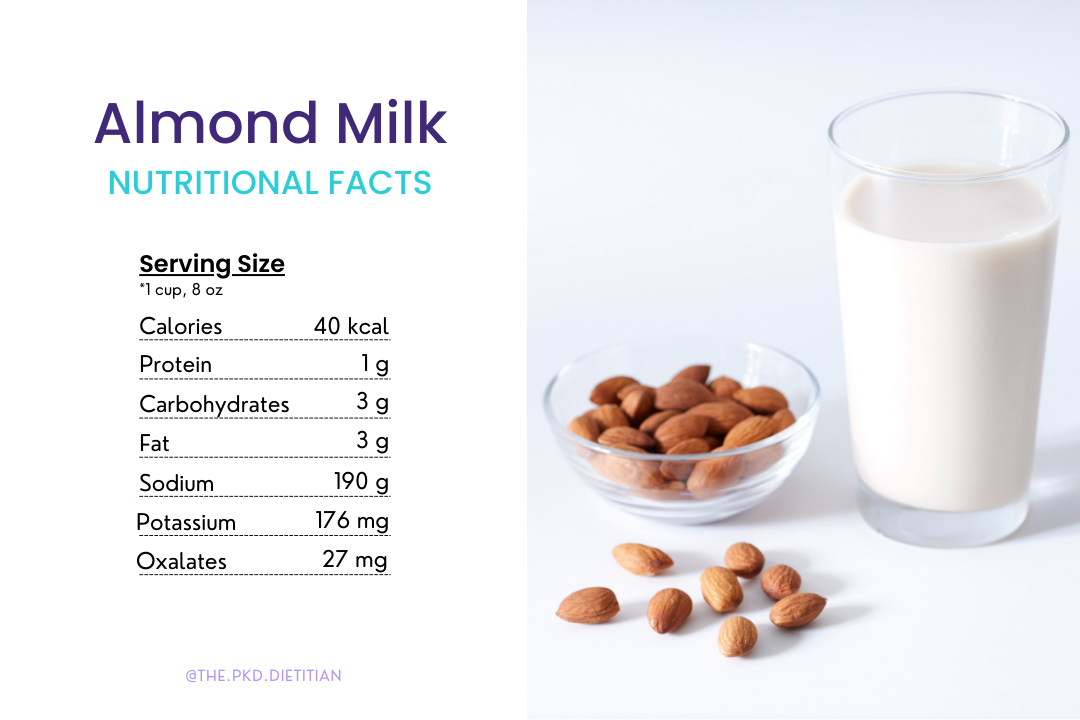
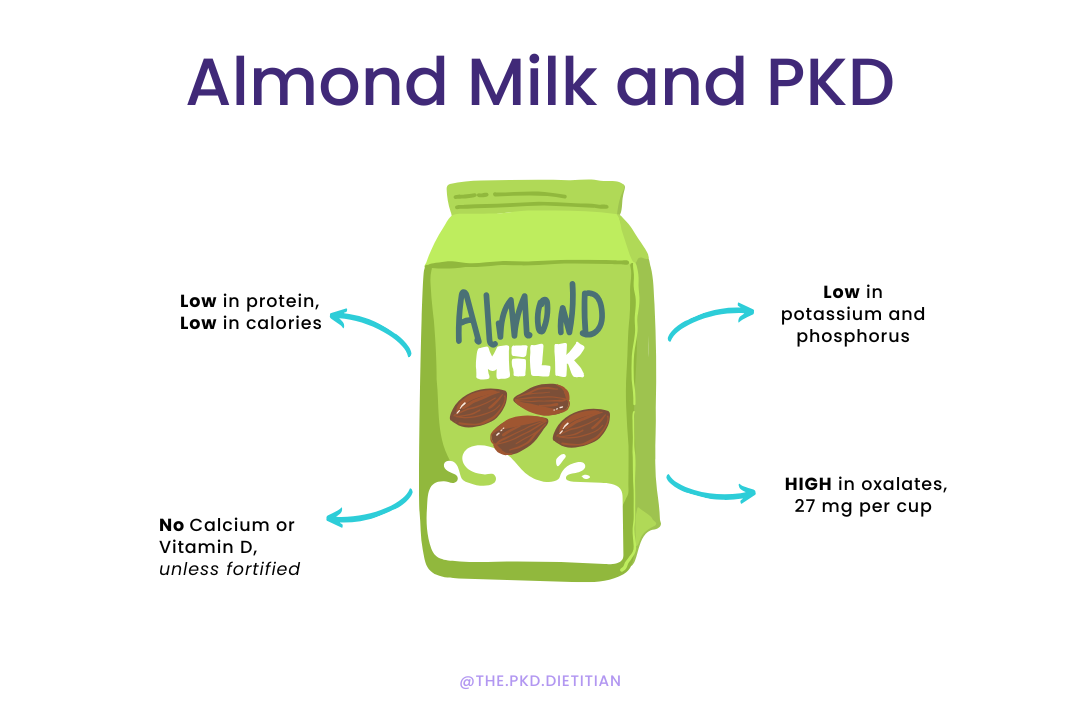
While almonds themselves are nutritionally dense, almond milk has been stripped of most of those nutrients. Almond milk is naturally low in protein, potassium, phosphorus, and calories. It is also lower in carbohydrates than cow’s milk and most plant-based milks.
Over 80% of commercially available almond milk products have been fortified. Please note, nutrients marked with ** indicate they are only present because they have been added through fortification. Amounts do vary by brand.
Serving Size: 1 cup (8 oz), unsweetened
- Calories: 40 kcal
- Fat: 3 g
- Sodium: 189 mg
- Carbohydrates: 3 g
- Fiber: 0 g
- Protein: 1 g
- Vitamin D: 160 IU**
- Calcium: 480 mg**
- Potassium: 176 mg
- Vitamin E: 7 mg
- Oxalates: 27 mg
- Vitamin B12: 0 mcg
Source: USDA FOODData Central
While almond milk might seem like a good option, especially if you have been told to limit potassium, protein and/or phosphorus— it's really the oxalate load that is worrisome for PKD. Understanding the oxalate content is especially important for people with PKD because of how oxalates interact with cystic kidneys.
Oxalate Load in Almond Milk
There is no way around it — almond milk contains a relatively high amount of oxalates and is considered a high-oxalate food. One cup of almond milk contains about 27 mg of oxalates.
To put this in perspective, a common diet recommendation for folks who have formed calcium oxalate stones is to aim for 100 mg or less of dietary oxalate a day. This is similar to guidelines I follow, and work on with my PKD clients. If you have formed stones and been told to limit oxalates because of it, almond milk likely isn't a good option for you.
If you have PKD and have made stones, now that nutrition can help prevent another stone. Learn more about nutrition and preventing stones with Polycystic Kidney Disease.
How Almond Milk May Impact PKD Kidneys
As a renal dietitian, who specializes in nutrition for PKD, my general recommendation is to avoid almond milk if you have polycystic kidney disease. While it's low potassium, phosphorus and protein may seem appealing — especially for individuals with advanced kidney disease who have restrictions — the potential risks often outweigh the benefits when almond milk becomes a daily staple.
Let me explain a bit more.
Why Oxalates Matter for PKD Kidneys
When PKD kidneys attempt to filter larger, or more concentrated amounts of oxalate crystals, it can activate PKD cyst growth pathways. This for sure isn't something we want to do, the exact opposite!
One of the goals with a healthy PKD nutrition plan is to reduce, or remove kidney stressors when possible. Oxalates are not only a kidney stressor for PKD, but can directly contribute to kidney damage through the formation of stones.
PKD and Kidney Stones
People with PKD have a higher risk of developing kidney stones compared with the general population. Kidney stones aren't just incredible painful — they can increase kidney inflammation, block urine flow, increase infection risk, and put additional stress on already vulnerable kidneys.
Many factors come into play around why this is, learning more about PKD and Kidney Stones and why there is a connection will help flush out (pun intended!) why and what you can do to prevent stones with nutrition. PKD and kidney stones isn't just about oxalate intake, it's more nuanced than that. However, proactively managing oxalates is protective for PKD and your kidneys.
Folks, this can be easy and stress free while also not being super restrictive. Learn 4 simple steps to oxalate management and make it easy!
The Verdict: Is Almond Milk Safe for PKD?
There is not a lot to almond milk, without fortification it is pretty lacking when it comes to nutrient density. The one thing almond milk is rich in is oxalates.
When it comes to a healthy PKD Diet, almond milk isn't a great option because of the increased risk it contributes to PKD complications and potentially to progression.
Fortunately, there are many dairy and plant-based milk alternatives that better support PKD kidney health while still fitting your taste preferences and nutritional goals.
Want personalized guidance and a PKD nutrition plan that protects your kidney function and supports long-term health? 👉 Learn more about how to work with me
Frequently Asked Questions About Almond Milk and PKD
Is almond milk safe for PKD?
Almond milk is generally not recommended as a regular milk choice for people with PKD due to its high oxalate content, which may increase kidney stress and kidney stone risk.
How much oxalate is in almond milk?
One cup of unsweetened almond milk contains approximately 27 mg of oxalates, it is a high-oxalate food.
Does almond milk increase kidney stone risk?
For individuals prone to calcium oxalate stones or those with PKD, regularly consuming high-oxalate foods like almond milk may increase stone risk.
What milk is best for PKD?
The best milk for PKD depends on your individual labs, kidney function, and nutrition goals.
Disclaimer: Blog posts are meant for educational purposes only. The information provided should not be used in place of advice from a medical professional.
References
- Borin JF, Knight J, Holmes RP, Joshi S, Goldfarb DS, Loeb S. Plant-Based Milk Alternatives and Risk Factors for Kidney Stones and Chronic Kidney Disease. https://pmc.ncbi.nlm.nih.gov/articles/PMC8611107/
- Bouhuwaish A, Ehnisch E, Arhaym AAH, Mohamed MMB, Velez JCQ. Excessive Ingestion of Almond Milk Causes Severe Hypercalcemia and Acute Kidney Injury in a Patient With Chronic Kidney Disease. https://pubmed.ncbi.nlm.nih.gov/40123931/
- Stepanova N. Oxalate Homeostasis in Non-Stone-Forming Chronic Kidney Disease: A Review of Key Findings and Perspectives. https://pmc.ncbi.nlm.nih.gov/articles/PMC10296321/
- Collard KM, McCormick DP. A Nutritional Comparison of Cow's Milk and Alternative Milk Products. https://pubmed.ncbi.nlm.nih.gov/33373745/
- Torres JA, Rezaei M, Broderick C, et al. Crystal deposition triggers tubule dilation that accelerates cystogenesis in polycystic kidney disease. https://pubmed.ncbi.nlm.nih.gov/31361604/
- Borghol AH, Azooz M, Bou Antoun MT, et al. Kidney stones and autosomal dominant polycystic kidney disease: a state-of-the-art review. https://pubmed.ncbi.nlm.nih.gov/41208250/
- Chasan O, Mirioglu S, Artan AS, Gursu M, Kazancioglu R, Elcioglu OC. Assessment of metabolic risk factors for nephrolithiasis in patients with autosomal dominant polycystic kidney disease: a cross-sectional study. https://pubmed.ncbi.nlm.nih.gov/37493903/
- Kuo LY, Casta Neda BN, Luo YE, Aslan Ceylan J, Andrade JE, Andrade JM. Impact of almond milk fortified with vitamin D3-loaded soy protein nanoparticles on serum 25(OH)D3 concentrations in adults with CKD: a pilot double-blind randomized controlled trial. https://pubmed.ncbi.nlm.nih.gov/40650716/
