
Episode 54 • February 2, 2026
What is Farabursen?
A RESEARCH REVIEW
Episode Highlights
1️⃣ Polycystin Protein = good for PKD!
2️⃣ Farabursen is an experimental medication that helps increase production of polycystin protein.
3️⃣ Early trials showed almost no kidney growth on Farabursen.
Resources
- Novartis, Clinical Trial Updates: https://www.novartis.com/clinicaltrials/study
- Farabursin Blog: https://www.thepkddietitian.com/blog/farabursen-what-is-it-and-how-does-it-impact-pkd-progression
Connect With Me
- Follow me on Instagram @the.pkd.dietitian
- Send me an email, ask a question, request a podcast topic: info@thepkddietitian.com
- Work with me:
Subscribe & Review ⭐️⭐️⭐️⭐️⭐️
If you loved the episode, please take a moment to subscribe and leave a review on Apple Podcasts! Your support helps the show reach more folks in the PKD Community who know that there is more to for PKD than sit back and wait for dialysis or transplant. 🎙 Thanks for tuning in to THE PKD DIETITIAN PODCAST.
Transcript
Welcome back to the PKD Dietitian Podcast. I'm your host Diana Bruen and today I have d research and science update episode for you. If you've been listening to the podcast for a while or if we're connected via social media then you know I love all the research, science, and discoveries around PKD that have exploded in the past five to ten years.
We have learned and are continuing to learn how PKD works, the pathways that are involved with it, and this has really given us opportunities for targeted therapy including new meds and nutrition opportunities. So today we're going to be diving into a promising experimental medication that's generating a lot of interest in the PKD community and it's called Farabursen In early studies it didn't even have a name.
It was known as RGL-S8429. Totally sounds like something out of Star Wars. So stick around to find out what it is, how it works, the results of the study so far, plus what is going to happen next before it could potentially be available to you and the PKD community.
And by the way, if you are a visual learner and able to access your phone or computer safely, pause this episode and pull up the blog that I wrote on this very topic. It's titled Farabursen, what it is and how does it impact PKD progression. I've linked it out for you in the show notes but also if you just google Farabursen and PKD you'll find it.
Polycystic kidney disease starts at the genetic level and every person on earth including you has two copies of the PKD1 and PKD2 genes. PKD, the disease, happens when there's a change called a mutation happens in one of these genes. This mutation alters that gene's instruction for making kidney specific protein molecules.
These molecules are essential for your kidneys structure and function. When these protein molecules aren't made correctly, that's when cysts begin to form and grow, disrupting and damaging normal kidney tissue over time. When I say protein, I don't mean the kind on your plate that you eat.
I am referring to small molecules made up of amino acids that your body uses to carry out vital functions. In order to understand Farabursen and how it could potentially slow PKD progression, we need to start at the very beginning. Your genes.
But first I want to do just a quick refresher on DNA and genes. Stick with me. I am going to keep it pretty simple and it will make it much easier for you to understand why Ferabursen is showing so much promise.
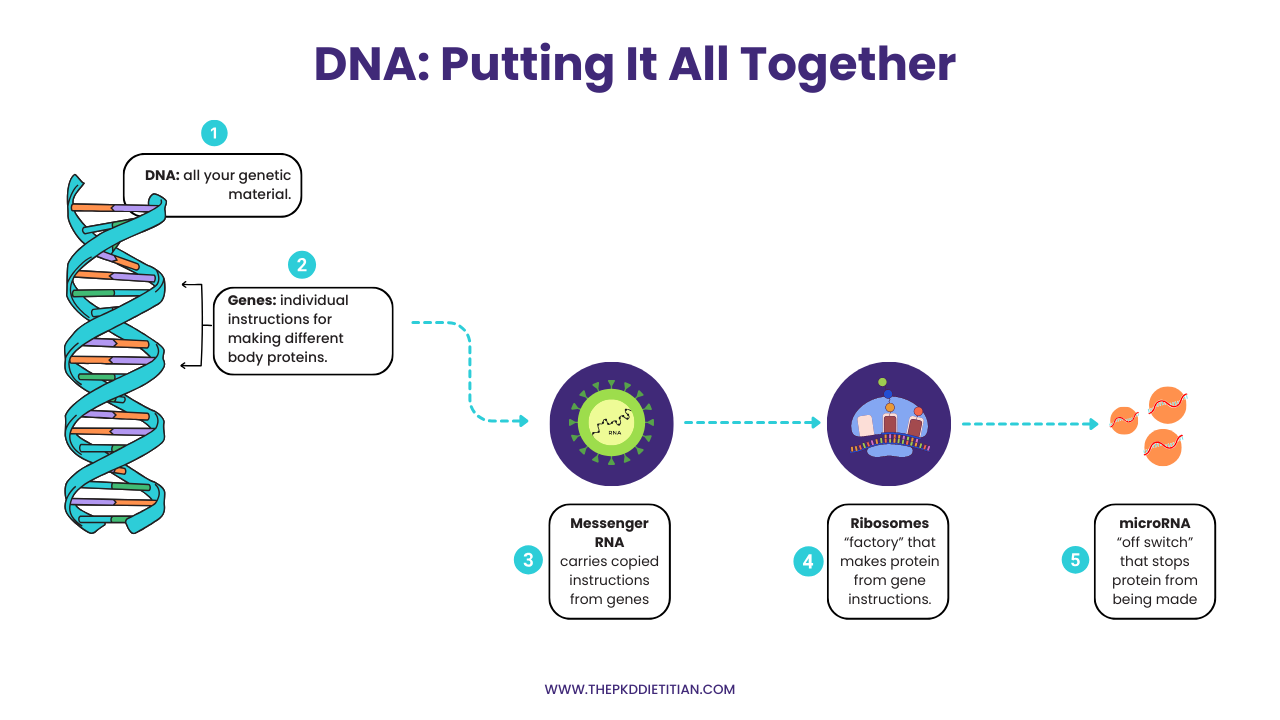
Let's start with DNA. DNA is a molecule that carries all of your unique genetic information. Think of DNA as your body's complete instruction manual.
Within DNA, there are individual instruction pages. These are your genes. A gene is a very specific section of DNA that provides your cells with detailed instructions for making body proteins.
Those different proteins each carry out a very specific function in your body. Some examples are they're used to build tissues in your body, they can be used to fight infections, and they even send signals between your cells. We each have over 21,000 different genes and each of them is a different set of instructions within our DNA instruction manual.
So the question is, what do our bodies do with these gene instructions? Our bodies copy those instructions so they can actively use them. Once your body copies those genes instructions, there is a molecule called messenger RNA that transports them. Now messenger RNA is exactly what it sounds like.
It's a messenger that carries those genes instructions, the copied ones, to where they need to be. And where those instructions need to be is in one of your ribosomes. When it comes to ribosomes, I want you to think of them as factories.
More specifically, they're protein factories. Those ribosomes read those copied instructions provided by that messenger RNA and follow them to make a new protein. A little sidebar on PKD here.
Both the PKD1 and PKD2 genes carry instructions for making proteins, just like the ones I'm talking about. And these proteins are called polycystin proteins. When either of those genes, the PKD1 or PKD2, are mutated, things can start to go awry in the kidney.
More on that in a moment. Back to our process of DNA and genes. There is one more step in this process and it is, how do we turn it off? When needed, there is a way to stop this protein making process, an off switch.
This off switch helps to regulate how much new body proteins are made from a specific genes instructions. This helps to make sure that everything is in check and to ensure your body and kidneys function smoothly. This is where another type of RNA comes into play.
This one is called micro RNA and these tiny molecules are a genes off switch. This little micro RNA binds to that messenger RNA and it essentially blocks them from sharing the copied gene instructions. Those copied gene instructions never make it to the ribosomes and the proteins are not made.
In short, micro RNAs stop genes from making too much of one type of protein. There you have it, your DNA in action, a quick refresher. Putting it all together, DNA is your body's complete instruction manual and within that manual, your genes are the individual instructions.
In order to use those instructions, messenger RNA carries a copy of them to a ribosome, those protein making factories, where those instructions are used to make the new proteins. Micro RNAs are the off switch for this process and they ensure your cells don't make too much of any one protein. Now that we've done a quick refresher on genes and DNA, I want to revisit the PKD genes themselves.
This is where I get to highlight how Farabursin is proposed to work. Farabursen is what is called an experimental medication. It just means it's a med that's still currently being studied.
In short, Farabursin targets a PKD specific micro RNA, that off switch. The goal is to make more polycystin protein to help potentially slow and or stop cyst growth and PKD progression. As I mentioned earlier, every human has two copies of PKD1 and PKD2 genes, one set from each parent, and those genes carry the instructions for making polycystin proteins, which are the important proteins for your kidney structure and for maintaining kidney health.
When PKD genes are mutated, their instructions get scrambled and this leads to cells that don't work as they should, setting the stage for cyst growth. With polycystic kidney disease, that micro RNA, the one that turns off the protein process, is up-regulated. What this means is there's a lot more of it than normal.
For those folks out there that like to geek out like me, the specific micro RNA involved with polycystic kidney disease is micro RNA 17. With PKD, there is more of this micro RNA, more of that off switch, a lot more. And this puts the brakes on or altogether stops the production of those polycystin proteins.
And in general, PKD'ers make only about 10 to 15% of what is considered a normal level of this polycystin protein. Essentially, PKD is a polycystin protein problem. So let's get back to If the micro RNA 17 is the off switch with PKD to making those good proteins, Farabursen acts like an on switch.
It's considered an experimental medication, meaning that it's still in trials. And Farabursen specifically targets that micro RNA. Farabursen targets that off switch and essentially blocks it so that those instructions for making that protein get to those ribosomes.
And you're able to make more of that good polycystin protein with a goal to slow, stop, or potentially completely halt cyst growth and PKD progression. What have we learned so far from the studies? There's been several studies around Farabursen looking at if it is safe and well tolerated, and also what good dose recommendations are. And so far in these trials, Farabursen, which comes in a shot was safe and well tolerated by people that took it.
And they have come to a conclusion about the optimal dosing too. What's really fascinating is that in the trials, the patients who were taking Farabursen had almost no increase in their kidney size, while those on a placebo saw their kidneys grow at a typical rate. Their urine also showed an increased level of polycystin, that important protein that people with PKD usually do not make enough of.
So this suggests that Farabursen is doing what it's supposed to do, helping the kidneys function more normally. And this is all very promising early data. The company that is developing Farabursen, a company called Novartis, plans to begin phase three trials, hopefully later this year, as of time of the recording of this episode.
Recruitment for the upcoming studies hasn't begun. The upcoming clinical trial has been reported to be for 12 months, so a 12 month intervention period. The results that they're going to be looking at is of course, the size of kidneys, the total kidney volume, and then they're also going to be looking at kidney markers, specifically EGFR, the kidney function.
So I know what you're thinking, how do I get involved? Where can I apply to be part of the study? As of the recording of this podcast, the recruitment for the study has not begun. Some earlier information around the study did highlight some of the criteria. Now of course, this is possible that it changes over time.
The criteria to be considered for participation in the upcoming trial include, if you are between 18 and 70 years old, you have a Mayo classification of 1C, 1D, or 1E, which are considering the faster progressing PKD. These are the same ones that are required for tolvaptan. If your kidney function, your eGFR is between 25 and 90, and you are not taking tolvaptan or Gynarque.
Now if you are taking them, in order to be considered, you can have what's called a three-month washout period. So essentially, you wouldn't take it for three months. So those are the basic criteria that have been previously presented.
Now what can you do? If you are interested in participating in the upcoming phase 3 trial for Farabursen, if you want to see if you qualify, talk to your nephrologist. Ask them if they have any further information on it, and potentially if that PKD center that you go to is participating in the upcoming clinical trial. That's where you should start.
That is it for today. I hope you found this as interesting and promising as I do. If you know someone who would benefit from learning more about Farabursen, or would potentially be interested in the upcoming trial, dates and locations to be determined, share this episode with them.
And please don't forget to rate and review the PKD Dietitian podcast. It helps others in the PKD community find it, and supports my mission of providing more access to solid and science-backed PKD health and nutrition information. And until next time, I'm Diana, the PKD Dietitian, and here is to happy and healthy eating.
References
- https://clinicaltrials.gov/study/NCT05521191#study-overview
- https://pmc.ncbi.nlm.nih.gov/articles/PMC5316862/
- https://pmc.ncbi.nlm.nih.gov/articles/PMC6085463/
- https://www.nature.com/articles/s41467-019-11918-y
- https://exonpublications.com/index.php/exon/article/view/81/91
- https://pubmed.ncbi.nlm.nih.gov/35965273/
- https://pmc.ncbi.nlm.nih.gov/articles/PMC7380379/
- https://pmc.ncbi.nlm.nih.gov/articles/PMC9376183/
- https://www.prnewswire.com/news-releases/regulus-therapeutics-announces-successful-completion-of-its-phase-1b-multiple-ascending-dose-mad-clinical-trial-of-farabursen-rgls8429-for-the-treatment-of-autosomal-dominant-polycystic-kidney-disease-adpkd-302412705.html
- https://www.novartis.com/clinicaltrials/study